Friday, April 10, 2009

Story and Discourse

If I am being honest, I haven't been quite sure of what the difference is between story and discourse. So here is my attempt of defining the two terms.

Story and discourse are the basic structures of telling a story. "Story" is the actual chronology of events in a narrative. Here's an example, and imagine this story as a movie:The dog woke up. The dog left his dog house. The dog met a little girl. The little girl likes the dog. The dog likes the little girl. The little girl takes the dog home with her. The END. Now when you imagined the story as a movie, what did you see with each shot? Were there close-ups, long shots, medium shots? What kind of music, if any, did you hear in the background? Regarding editing, did you dissolve to each scene or did you use hard cuts? All of these elements are what we call "discourse". "Discourse" are the tricks, manipulations, and effects you use in order to make that story effective, and it applies to every movie we see.

A good example of story and discourse is the film Triumph of the Will. The story of Triumph of the Will is a four-day chronicling of the 1934 Nazi Party Congress in in Nuremberg, which includes speeches by various Nazi leaders and Adolf Hitler himself.

On Day 1, Hitler arrives at Nuremberg to thunderous applause from the Germans and is driven through Nuremberg with adoring admirers watching to his hotel, where a night gathering is held. On Day 2, The opening ceremony begins and several Nazi leaders give speeches. Then an outdoor rally is held for the Germany's Labor Service. The day ends with a parade.
On Day 3, a Hitler Youth rally is held. That night, Hitler delivers another speech to German officials.
On Day 4, Hitler walks through a long aisle with thousands of soldiers at attention to lay a wreath at World War I memorial. Hitler then delivers several speeches while the audience sees several nation-building activities occuring.

Examples of discourse in Triumph of the Will:
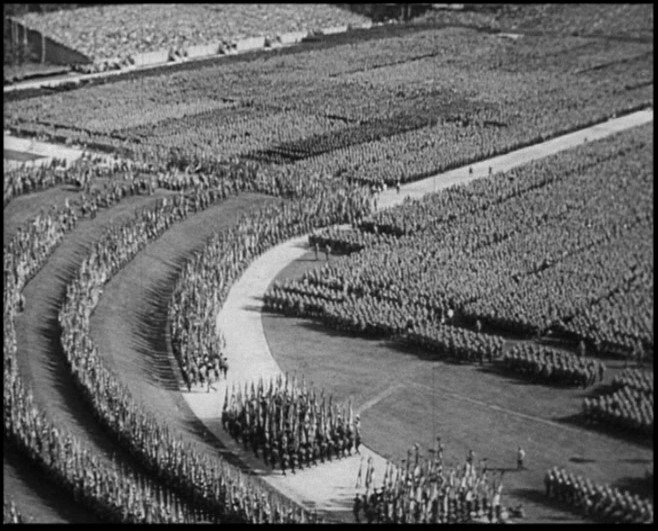
This aerial shot of soldiers marching and standing at attention shows the majesty and patriotism of this event. It relates to the audience as something big is happening in this country's history.

http://www.historyplace.com/worldwar2/triumph/triumph-will9b.jpg


http://1.bp.blogspot.com/_6mGHoKxDQK8/RcEq-s2j96I/AAAAAAAAACE/D5b8FINu7ko/s400/youth.jpg Here is a shot of a young man sounding a horn. This shot is important because historically, the sounding of a horn is indicative that a great event is about to transpire.


Now that I understand the difference between story and discourse, I am now left with the question of how does the same tricks of discourse apply to some of our mediums today. Someone in class raised the question if we would feel the same if it was Obama presented in a similar fashion as Triumph of the Will. I found a video online created by the Barack Obama campaign that use similar techniques of Triumph of the Will. Watch it and tell me what do you think.

http://www.youtube.com/watch?v=eCeNPAaGVVY

Friday, February 27, 2009

Color Me Black And White

Before I get started, I have to be honest. I have not been terribly engrossed in the class for the past two weeks since we have been going over this film noir genre or style or whatever you want to call it. In fact, I have been bored for the most part until I saw Kiss Kiss Bang Bang this past Wednesday. Up until this point, I
found film noir to be this stale, unentertaining, so-not-colorful-in-so-many-ways-than-one genre. Even though Kiss Kiss Bang Bang kinda parodied film noir movies, it made me more interested and more appreciative of real film noir films. Plus, I got a really good laugh out of the movie! It made me see all the good things about film noir and not focus on the annoying things about it. If anything, Kiss Kiss Bang Bang was a satirical instruction manuel to film noir. So when I went back to look at Out of the Past and Chinatown, I did not find them to be as humdrum or as unexciting as they were when I first saw them.
Anyway, over the past week, the debate of the status of film noir in movie history has been going on in our class. Up until this point, I had decided to stay out of the debate because a) I was not all that enthralled in the topic at that point and b) before this class, I had always thought of film noir as a genre so in my mind, there was no reason for a debate to begin with. Then I read Paul Schrader's "Notes on Film Noir" and Steve Neale's "Questions of Genre". After reading their thoughts, I was forced to think about what qualifies as a genre and what qualifies as a style. After much thought, I came up with my answer. A genre is a category of film (music, literature, or whatever floats your boat) that provides a criteria, strict or relaxed, to be classified for the benefit of the viewer. Style is the way one uses elements to make up your piece of art. For example, when we look at horror movies, we expect fear as a driving force in the movie. When we look at romance films, we expect love as the main source of energy. When we look at action flicks, we expect a semi-decent plot with million-dollar explosions, edge-of-your-seat car chases, and dangerous fight scenes. With that being said, I am going to have to side with Schrader on this one. Film noir is indeed a style and not a genre.

I say this because film noir does not create a set of criteria like genres do. It is possible for a movie to be a crime flick with film noir elements. Just like it is possible for a crime movie to have another set of elements. No matter what, that movie will be a crime flick. It is just up to the director to determine what style he will use in order to illustrate his movie. Get what I am saying? If not, Schrader explains it really well: "Film noir is not a genre. It is not defined...by conventions of setting and conflict, but...by...qualities of tone and mood."
Now while I have admittedly been very critical of film noir, I am grateful of its utilization of a strong, intelligent, beautiful, and dangerous woman - otherwise known as the femme fatale. This rejection of the conventional roles of women like devoted wife and loving mother was needed in order to diversify roles for women. However, when you really think about it, film noir still shows women as what men allows them to be. And when women become self-sufficient, independent, and powerful, they will be punished in the end. I guess the psychological power of the "male gaze" (aka male control) still rears its ugly head - even in film noir.

Friday, February 13, 2009

This Is A Man's World???


Many would argue that men rule the world and ultimately dictate society and its beliefs. Since cinema is a reflection of society, it is natural to deduce that films are styled from what Laura Mulvey's Visual Pleasure and Narrative Cinema called the "male gaze." In her essay, Mulvey employs psychoanalysis to determine the cinematic patterns of fascination that have shaped audiences. She uses psychoanalysis to explain the way in which the patriarchal society we live in influence and translate onto the films we watch.
In the blockbuster romance film, Titanic, we see a classic rich-girl/poor-boy love story that is driven by two opposing male or (male-influenced) forces: "Cal", the rich but controlling fiancé who wants "Rose" as a trophy wife and "Jack", the broke yet loving artist who wants "Rose" to break free of her degrading relationship with "Cal" and start a new life with him. In this film, the audience has to assume that the characters live in a "phallocentric society." According to Mulvey, this means that this is a society that standardizes the acknowledgement of men and their sexuality towards women. And anyone who has seen Titanic knows that for most of the part in the movie "Rose's" body is either being used as a life-size jewelry-decorated Barbie doll by the evil "Cal" or immortalized through "Jack's" male gaze during the famous nude drawing scene. In both cases, despite either character's intentions, they used "Rose's" body for pleasure for themselves.
Notice how neither male character's body is exploited or displayed in the same fashion as the female character. The answer is simple. Because according to Mulvey's "phallocentric society", everything must be geared towards fulfilling and strengthening the male ego and inhibiting any desires of women. That means that men are the dominant gender that controls women and their sexuality, and it does not feed the male ego when a woman is in charge of her own sexuality. Mulvey explains this as a fear through psychoanalysis. Even though the female figure is pleasant to the eye, she is to be controlled because she represents the lack of a phallus - a castration danger.
Both Christian Metz and Laura Mulvey touch on the same subject in their articles: scopohilia. Scopohilia is literally the "love of looking." When related to Hollywood cinema, the term suggests the male figures enjoying the women being gazed upon as objects, not as humans with their own thoughts and opinions. In her article, Mulvey identifies three "looks" that objectifies women. The first is the viewpoint of the male character and how he views the female character, which is usually satisfying to the male. The second is the viewpoint of the audience and how they view the female character. The third look is a combination of the two. The male audience adopts the same perspective as the male character and objectifies the female character as their own personal sex object. For example, when asked their favorite scene in Titanic, many men referenced to the scene where "Jack" draws a nude "Rose" donned in jewelry and being objectified by a man. This is a classic case where the male audience adopted "Jack's" perspective and made "Rose" their object of sexual desire and dominance.
When reading all of these articles, I found all this information to be very sexist and skewed in a way that does not capture all of what society is and what it can be. I am aware that this information is being communicated through a purely psychoanalytic view, but I do think that we do not give men or women enough credit for advances in gender equality. While I do think that in many ways we do live in a patriarchal society, women have made incredible strides with showing women in leading and dominating roles and men in more sensitive and emotional portrayals.

Sunday, February 1, 2009

Under Your Suspicion

Let's be honest: romance movies are cheesy. Film noir romance movies can be down right preposterous and absurd. Life does not go into slow motion when you see your lover after a prolonged absence. A full orchestra does not play in the background when you share your first kiss. And there are no wind machines to provide a classic breeze through your hair when you see an attractive person from across the room. Yet we see all of these elements in love story after love story after love story, and that does not stop the legions of audiences that flock to these films to rekindle their own ideas about love and romance.
In Alfred Hitchcock's Suspicion, many summaries indicate this movie as a suspenseful, psychological thriller. And while that may be, this is as much of a romance movie than any of the other two genres. With great help with the not-so-subtle acting of Joan Fontaine (with the aid of Hitchcock's directing, of course), the not-so-believable writing of Samson Raphaelson, Joan Harrison, and Alma Reville, and the not-so-realistic grand orchestra music that played nearly every time "Johnnie" and "Lina" embraced, Hitchcock's Suspicion is a love story first and a psychological thriller second.
In Suspicion, we meet a charming "Johnnie" who manages to make "Lina" fall in love with him and marry him. However, nearly right after the honeymoon, "Lina" finds out that her Prince Charming has a shady past that includes embezzling money and possibly murder. After a friend of theirs die suspiciously, "Lina" becomes more than convinced that her husband is after her. However, after being given a eerily-glowing glass of milk and a frighteningly trip down a coastal road, "Lina" realizes that "Johnnie" did not kill their friend and that "Johnnie" was planning on committing suicide to save himself from his collected debts and his wife from the shame of an incarcerated husband.
One would really have to look at the movie themselves and not judge it based off a synopsis to realize that this is a love story. The biggest give away was Cary Grant's ("Johnnie") and Joan Fontaine's ("Lina's") acting. Even in the darkest of moments, such as when two police officers arrived at "Lina's" home to investigate "Beaky's" death, you could see the conflict of love and fear in "Lina's" eyes. In the scene when "Johnnie" makes it to the ball and "Lina's" notices him, the exaltation between the two of them leaps off the screen.
Hitchcock makes great use of narrative space in Suspicion. The scene that jumps out at me is the infamous glowing milk scene. The shadows played well up against the few pockets of light that shined through the glass ceiling from above. Of course, the best piece of lighting is the light that emanates from the glass milk. Prior to that scene, "Johnnie" had been fascinated with untraceable poisons, which provided a good hint to the audience that "Johnnie" was going to poisoned "Lina". However, since 'untraceable' is not that exciting visually to an audience. The glowing milk was a screaming piece of narrative to let the audience know that something was amiss in this situation. As "Johnnie" approached the top of the stairs, the milk became brighter, which hinted that the revelation of "Johnnie's" true intentions were going to become plain and seen for Lira (including the audience).
This was a great movie. The over-the-top antics did grate my nerves, but one has to take into account the times that the movie was made in and how that was the standard back in those days.

Sunday, January 11, 2009

The number one rule of Fight Club...

I have to say that this movie did a tremendously better and more entertaining job of capturing my attention than what my notoriously low expectations were...uh...expecting. As good-looking as he is, I have never really been a fan of his acting. To me, it is very "movie-star generic." Neither good or bad. You do not come to a Brad Pitt flick to see how well he is going to mold himself into a role. Let's be honest...you come to see how smoldering he is going to be up on the big screen. Anyway, Pitt does well in his film as the imaginary, kick-ass, alter ego of the narrator's split personality, but the true star of this film is of course, the narrator. He represents the outer shell of painless, numb, routine-driven drones that most people become (including myself) and weirdly finds emotional freedom from going to a series of support group meetings initially and later on, getting pummeled for sport.

Now while this is cinematic extremism at its finest, this is one of the things films do best.
They show us the most intense "out-there" situation and while we, the audience, "ooh" and "ahh" at it, by the end of the movie, the film is really showing us a mirror that is reflecting our stories, our dreams, and most entertainingly, our insecurities. While I doubt any of us have alter egos of our own split personalities, the narrator's situation is not all that uncommon. Look at the common reasoning of addiction: escapism, be someone else-ism. (LOL! Sorry, I just had to put that in there) When you are dancing in a dark club with music blasting and drinking alcohol, I highly doubt you are the same person you are when you are sitting in class, answering your professor's questions. Of course not! Because when you are that uninhibited person, you know deep down that this person cannot survive in this routine-driven, capitalistic world. So you save them for a place where they can survive. And that's what the narrator did in a schizophrenic and sadistic kind of way. This film capitalizes on what makes all good films indeed "good": relationships. Whether it is a relationship with ourselves, our imaginary friend, our support group-abusing lover, or our bitch tits-having sob mate, films teaches us that there is a relationship to any and everything around us - through story and the actual technicality of the technology films use.

One of the things that keeps people watching movies over and over again is that movies gives us a chance to develop our view of the world This brings me to Walter Benjamin's "The Work of Art in the Age of Mechanical Reproduction". In section XIII, he explains in so many words that technology have burst open the lives that have had us "locked up hopelessly." That no matter how many times you have seen an action being done, through film and its effects, you can begin to see it the way a newborn sees it. Through film, we learn the relationship between the subject and our inanimate environment. With slow-motion, we learn how far the sweat drips off of our face during a workout to the ground that it will eventually splatter on. Through close-ups, we can see the detail of our fingers as we type each keystroke in what seems like a fraction of a section. Through wide shots, we can see our beloved planet Earth from a point of view that only astronauts are lucky enough to see. I believe Benjamin said it best: "The camera introduces us to unconscious optics..."