Story and discourse are the basic structures of telling a story. "Story" is the actual chronology of events in a narrative. Here's an example, and imagine this story as a movie:The dog woke up. The dog left his dog house. The dog met a little girl. The little girl likes the dog. The dog likes the little girl. The little girl takes the dog home with her. The END. Now when you imagined the story as a movie, what did you see with each shot? Were there close-ups, long shots, medium shots? What kind of music, if any, did you hear in the background? Regarding editing, did you dissolve to each scene or did you use hard cuts? All of these elements are what we call "discourse". "Discourse" are the tricks, manipulations, and effects you use in order to make that story effective, and it applies to every movie we see.
A good example of story and discourse is the film Triumph of the Will. The story of Triumph of the Will is a four-day chronicling of the 1934 Nazi Party Congress in in Nuremberg, which includes speeches by various Nazi leaders and Adolf Hitler himself.
On Day 1, Hitler arrives at Nuremberg to thunderous applause from the Germans and is driven through Nuremberg with adoring admirers watching to his hotel, where a night gathering is held. On Day 2, The opening ceremony begins and several Nazi leaders give speeches. Then an outdoor rally is held for the Germany's Labor Service. The day ends with a parade.
On Day 3, a Hitler Youth rally is held. That night, Hitler delivers another speech to German officials.
On Day 4, Hitler walks through a long aisle with thousands of soldiers at attention to lay a wreath at World War I memorial. Hitler then delivers several speeches while the audience sees several nation-building activities occuring.
Examples of discourse in Triumph of the Will:
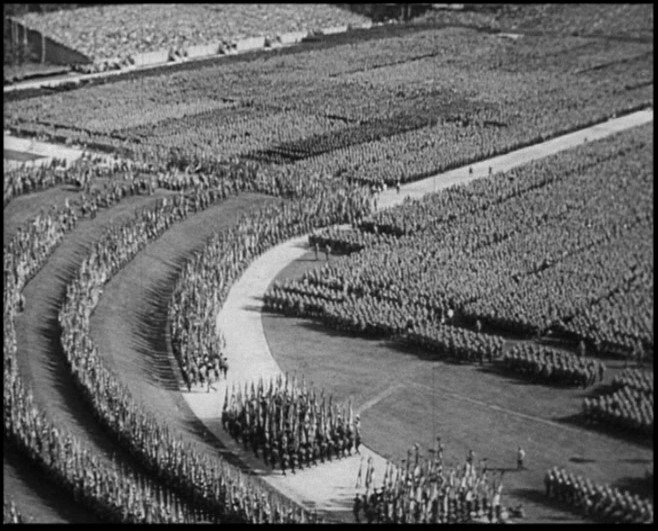 This aerial shot of soldiers marching and standing at attention shows the majesty and patriotism of this event. It relates to the audience as something big is happening in this country's history.
 Here is a shot of a young man sounding a horn. This shot is important because historically, the sounding of a horn is indicative that a great event is about to transpire.
Now that I understand the difference between story and discourse, I am now left with the question of how does the same tricks of discourse apply to some of our mediums today. Someone in class raised the question if we would feel the same if it was Obama presented in a similar fashion as Triumph of the Will. I found a video online created by the Barack Obama campaign that use similar techniques of Triumph of the Will. Watch it and tell me what do you think.
http://www.youtube.com/watch?v=eCeNPAaGVVY

7 comments:
The "Four Days in Denver" video doesn't parallel "Triumph," because within the first minute, the tools of enunciation are revealed in the back room, such as the monitors, cameras, and equipment, which establishes this video as a behind the scenes look at a great man. Instead of covering, it reveals and doesn't suffer from the delusions of grandeur that plagued "Triumph." However, the makers of this video wanted to forward an idea of Obama being accessible, down to earth, and a family man, and that's exactly what was presented. Not as dangerous an ideology as Aryan supremacy and unquestioning nationalism, but it is a political tool none the less that uses conventions such as hand-held cameras, eye-level height, and enunciative moments to forward its ideology: the "humanness" of Obama.
I really liked how you walked readers through examples of specific shots used in Triumph of the Will by including the actual images.
With regards to the Obama campaign video, I agree with Rachel that it does not have nearly the same effect as Triumph of the Will because, as she mentioned, it doesn't try at all to cover up the tools of enunciation. In fact, it almost has a home video quality to it since it is so obviously being filmed by someone. For instance, there are parts of it when the frame is shaky and it looks like a hand held camera is being used. Also, at one point Michelle looks and speaks directly into the camera, since she knows it is being filmed and people are watching her. There are also a lot of shots of the kids (typically the people who star in home videos). This style of enunciation communicates Obama's family ideals and his accessibility, very different qualities from the qualities of Hitler brought out in Triumph of the Will.
I agree with Shayna; I like how you walked us through the differences between story and discourse with the set examples in Triumph of the Will. That being said, though, I'd also have to agree with both Rachel and Shayna when they said that there is a difference between the specific example you used and Triumph of the Will. I agree that the almost fethishization of political figures can be very problematic; propaganda always is. However, by deliberately making the tools of filming evident (like the cameras, the monitors), the film becomes less propaganda and more an insider's look into Obama-the-man.
On the other hand, however, I do believe that this sort of insider's peek could potentially be just as insidious. It presents us a few of a person, rather than a political figure, and people are more inclined to like the former.
I think rather that elevating the main protagonist to the level of a 'superior', as is done in Triumph of the Will, 'Four Days in Denver' seeks to allow its audience to relate to and experience Barack Obama the family man rather than Barack Obama the politician. Unlike in Triumph of the Will, where the camera work is still and austere, Four Days in Denver has scenes in which the camera is shaking as if to mimic a home video. I think this pulls away a layer of formality and superiority between Obama and the viewer and draws the two closer.
You do a clear and concise job of defining where discourse can affect story. If we look at these two videos, the story parallels are evident: both involve a political rally, kids, grand speeches given from podiums to a mass audience, effect of the leader on "smaller" individuals. Both also try to convince the viewer of the individual's greatness as a leader.
But the discourse, the way the filmmaker goes about telling this basic story, is clearly different. In "Four Days in Denver", the grandiose, "power-image" type shots are all gone. The film tries to capture the human side of this leader, not the other-worldly nature about him. But, nowadays, it's those people that can retain their humanity and modesty in such other-worldly positions that makes them powerful. The modern filmmaker from
"Four Days" knows it's almost as much about the images behind and/or after the stereotypically "power images" that captivate the viewer.
Intersting move here Afftene. I affirm your impulse to enact the discursive (generating an exciting discourse amongst your classmates/readers) by putting 4 Days in Denver in conversation with Triumph of the Will. This implies that you understand that discourse is not just the set of techniques used to tell a story, but also the way those techniques place that story into an ongoing conversation with other films/stories/representations.
best,
lex
I didn't quite feel the same effects the Triumph of the Will inspired in me from the Obama video. I felt that the aims of the two clips were somewhat different. While Hitler was elevated to a Demi-God status, Obama is more seen as a personable human being just like the rest of us are. Despite that, I felt that you introduction or example in the beginning of the blog was very well placed and explained discourse in a very easy to understand manner. I wish that you could have just talked a little bit more about how the various elements (music, camera shots, etc) affected the way you viewed Triumph of the Will, because you definitely mention these elements but not in the context of the film (you do to some degree but it would be better if you expanded that).
Post a Comment